The post A Copywriter’s Honest Thoughts on AI Copywriting appeared first on Kayla Hollatz.
]]>I’ve been asked this on airplanes and phone calls. I’ve heard it at restaurants, coffee shops, libraries, and dog parks.
Everyone is curious about the future of AI, and who better to ask than writers? With the rise of AI copywriting, we’re one of the first professions that’s been hit (yippee  ).
So, how would I answer this nuanced question?
It’s not that I’m not afraid AI will replace human creativity. (It can’t.)
I’m far more concerned with how quickly AI has impacted the perceived value of our human creativity, and how little we seem to be questioning it.
The shadow side of AI copywriting
As a decade-long, solo-by-choice copywriter, my stance on AI won’t shock you.
There are far more written in favor of AI than not, and this is not that. We rarely hear from people who are willing to question its ethics and assess its drawbacks.
You won’t find many of us on social media, and we’re quite scarce on LinkedIn (*shudder*), but we are out there. And it’s time we talk about it.
AI shrinks our critical thinking
AI is actively rewiring our brains to believe work shouldn’t be hard. Why should we sit in silence for a good idea if AI provides multiple outputs within a few seconds? Why should we wait for our brains to catch up?
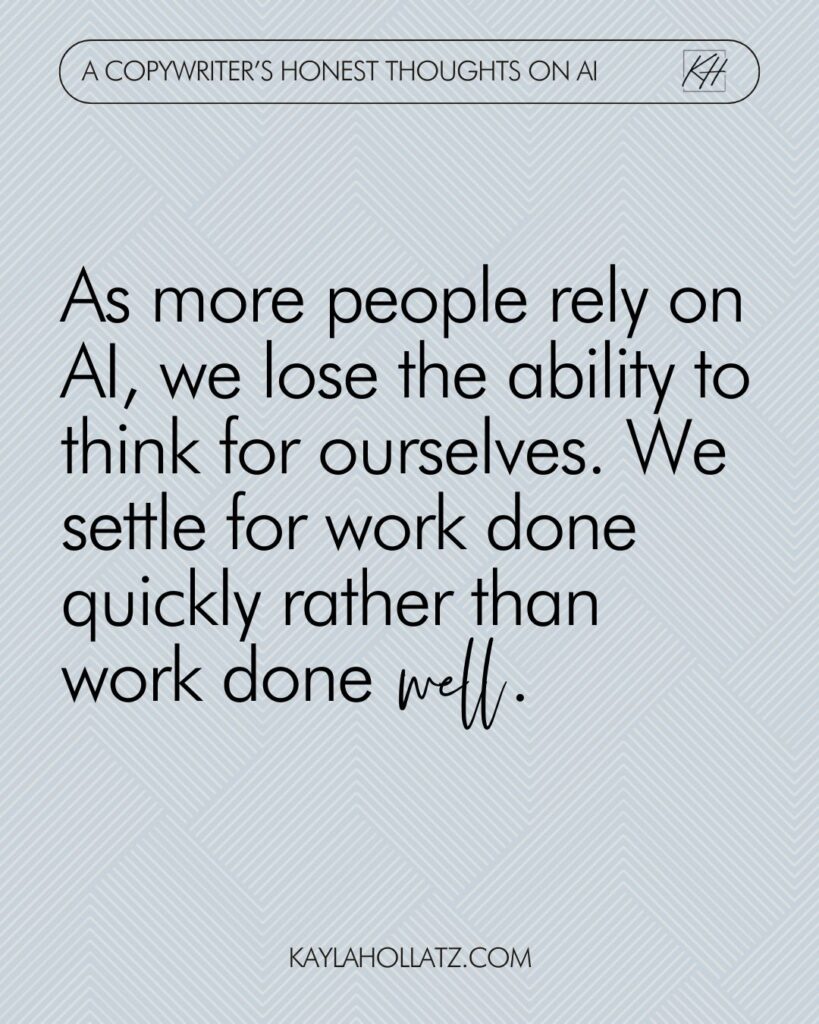
As more people rely on AI, we become digitally dependent. We lose the ability to think for ourselves. We settle for work done quickly rather than work done well.
Emma Tarp, a fellow copywriter and dear friend, writes that “good writing starts with good thinking.” And good thinking results from embracing quiet moments of solitude, allowing space to challenge ourselves and think clearly.
A new MIT scientific study on ChatGPT confirms this, proving that ChatGPT users “consistently underperformed at neural, linguistic, and behavioral levels.” After several months of using AI, users were said to have gotten “lazier with each subsequent essay, often resorting to copy-and-paste by the end of the study.”
Think of it this way. When AI does the heavy lifting, we don’t need to flex our creative muscles. Much like our physical body, when we stop using a muscle, it undergoes atrophy. We no longer use the muscle effectively due to its inactivity.
AI has the same impact on our creativity. That’s why we must limit our reliance on AI, because time is not our enemy; speed is.
AI saves time, but at a great cost
Most arguments in favor of AI copywriting come from people who say it saves time and money. To a certain extent, I can see their point, but that means we value efficiency over effectiveness.
Consider the content farms from the early 2000s. By quickly producing low-paid, low-quality content, content farms took a “quantity over quality” approach in hopes it would help them better rank on Google. Spoiler: It didn’t.
In early 2011, Google took action against content farms, adjusting its algorithm to deprioritize sites with “shallow” and “unoriginal” content. (Sound familiar?)
Because search engines care about keeping our attention, they’re only interested in ranking the highest quality content available. And all copywriters know content creation takes time. We’re talking about research, strategizing, outlining, writing, re-writing, editing, publishing, and promoting.
I’m not against technology making these steps easier, but eliminating our creative input seems unwise. Speed has never been the greatest metric of success, and content created in a hurry rarely makes a lasting impact.
If speed becomes more important than connection, we may also forget about the power of writing what Ann Lamott calls a “shitty first draft.”
In her book Bird by Bird, Ann says, “All good writers write them. This is how they end up with good second drafts and terrific third drafts.” She reminds us that no one “writes elegant first drafts,” not even the most beloved authors.
I know AI enthusiasts may counter this by saying AI can produce a shitty first draft for you, but then AI sets the tone of your story. It determines where your narrative goes. In turn, you surrender your position as the captain of the ship.
I’m not willing to give that up when crafting a story, and I don’t believe I’m alone.
AI is derivative by nature
AI has become an essential brainstorming companion for many creators. Some call AI their “partner” or “second brain.” Others have back-and-forth conversations with AI as if it’s simply another team member.
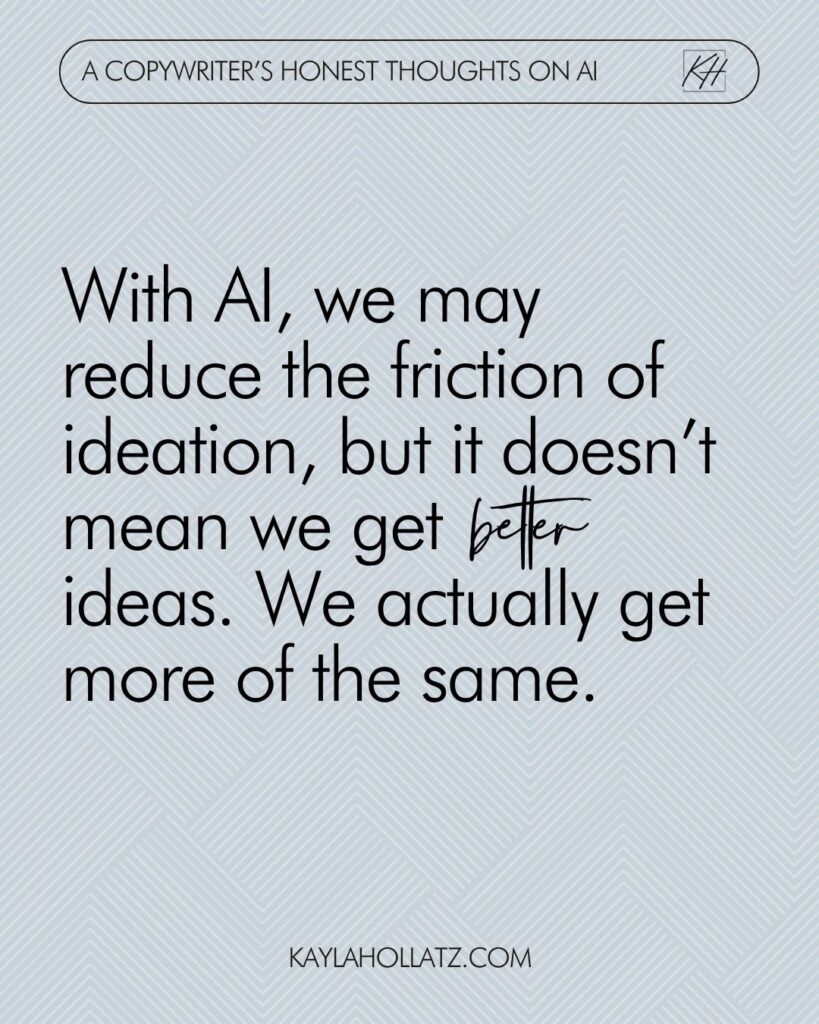
By using AI, we may reduce the friction of ideation, but it doesn’t mean we get better ideas. We actually get more of the same.
There’s a lot of talk about how easy it is to see through AI-generated content. Copywriter Laura Belgray noticed AI typically relies on “formulaic phrases, vocab quirks, and try-hard humor.”
The consensus is that AI copywriting is a turn-off, yet it’s still widely used. Why? Because it promises an easier road to success, even if you end up sounding like everyone else. Yes, even like your competitors.
I also find it interesting how many business gurus have changed their tune over time. The same influencers who made millions off of telling us to discover our voice and embrace what makes us unique are now the first ones selling courses on AI copywriting. I can’t be the only one seeing the irony in this, right?
Someday, I hope we’ll reach a point where everyone will crave what feels human again, but until then, writers and artists must keep creating because that’s what we do best.
AI is unethically trained
Since AI is unable to create anything original, it must get its information from somewhere. Therein lies one of our biggest ethical dilemmas.
If you have published your work online—blog posts, website copy, you name it—you have likely trained AI bots without knowing it.
Let that sink in for a moment.
Some online platforms are rolling out optional features where you can block AI training, but they are few and far between. Unfortunately, selecting this setting on Substack means you’ll “limit your discoverability” on their platform—all because you want to protect your IP.
Without AI regulations, creators like you and I are stuck in a lose-lose scenario. Our entire body of work can be taken without notice or permission. Today, it’s our words and ideas; tomorrow, it’s our designs, photography, and art.
And it’s not just our online work that’s at risk.
My friend and author Cait Flanders recently wrote about her feelings after learning both of her novels were stolen by Meta AI, along with 183,000 other authors. And this is only the beginning. Editor and author Stephanie Duncan Smith calls this a “creative break-in,” a copyright violation that hits close to home.
Ignorance is bliss, so perhaps the public isn’t aware that their AI tools are trained from stolen content or that it negatively impacts our environment. But once we have an understanding, we get to decide how we respond.
AI cheapens the human experience
By now, you realize AI only knows how to take what makes us human and manipulate it.
It can’t share personal anecdotes. It can’t feel emotion or delight in a sensorial experience. It can only mimic what it’s given.
Your experiences. Your stories. Your emotions. That’s what matters. That’s what endures, yet we forfeit our voice when we give creative control over to AI.
Maybe you’ve seen the trend where people ask AI to give them a pep talk or summarize their voice and personality in a few sentences.
Some creators are making monumental decisions in their lives and business based on what AI says, allowing it to influence their mood and thought life. But just because something sounds good and feels good doesn’t make it right.
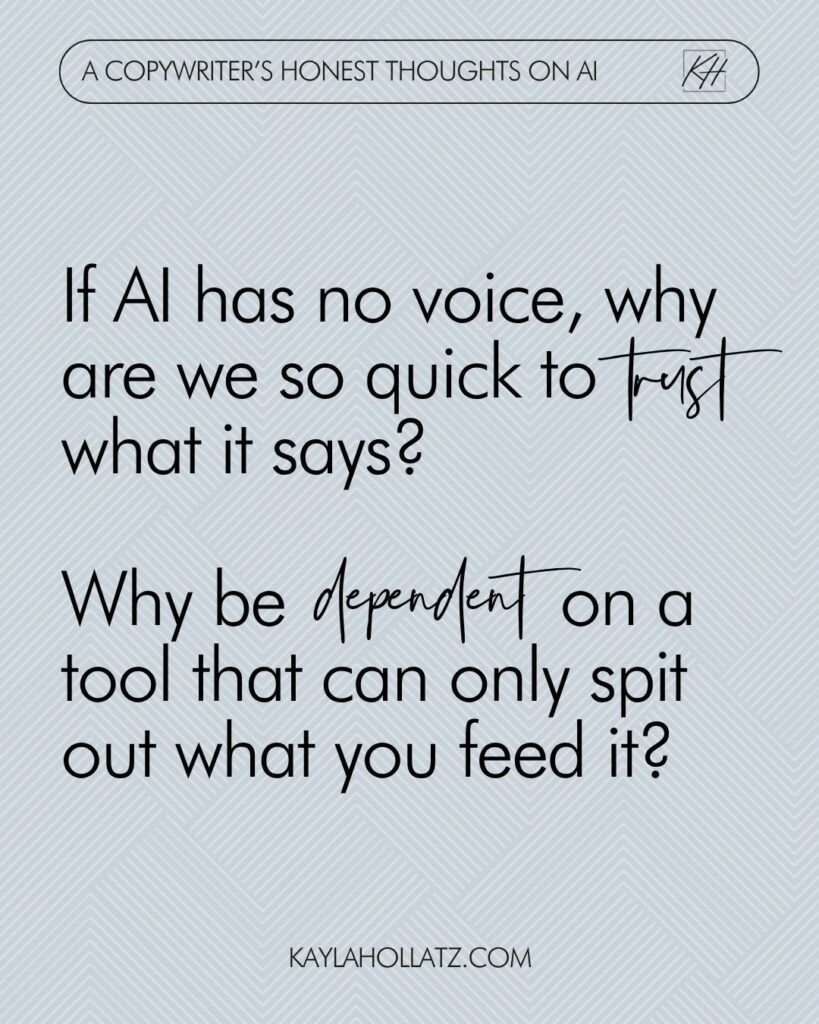
If AI has no voice, why are we so quick to trust what it says?
Why be dependent on a tool that can only spit out what you feed it?
I’m aware this may sound like a crusade against AI, but my greatest hope is to ignite an open conversation. I believe we are meant to question these advancements, especially with how quickly AI technology is progressing.
What can we do to combat AI copywriting?
The future is still largely unknown, but one thing’s for sure: AI is here to stay.
While AI grows stronger and more sophisticated every day, we have an opportunity to respond differently. It may feel like we’re fighting an uphill battle, but there are many things we can do right where we are.
Eliminate (or reduce) your AI use
- Sit in silence until an idea appears, even when it feels uncomfortable.
- Brainstorm with a pen and paper, even if you can type faster on a keyboard.
- Read physical books and long-form content, even if you feel bored.
- Test your theories and ideas, even if you’re tempted to use a formula.
- Go to a trusted friend or coach, even if they don’t give you a quick answer.
Boldly share your beliefs on AI
- Start an open conversation on social media.
- Write your honest thoughts through a blog post (like this!) or email newsletter.
- Have private conversations with other friends in your industry.
- Share your unique perspective during a podcast guest interview.
- Wrestle well and respect other creators who view AI differently.
Partner with like-minded clients and collaborators
- Ask client leads how they view and use AI within their business.
- Transparently share how you use (or don’t use) AI in your creative process.
- Create a referral list of partners who similarly value human creativity.
- Simplify and strengthen your creative process with other value-aligned tech.
- Create a memorable, personal client experience that AI could never offer.
This list isn’t exhaustive, but I hope it serves as a starting point for those who want to take practical, daily actions.
So, where does this leave us, individually and collectively? We get to decide—even if it feels like the world has already made its decision. And there’s power in that.
If you want to have an open conversation about AI, let’s talk on Instagram, or we can connect through my email newsletter, where I’ll write more on this subject.
The post A Copywriter’s Honest Thoughts on AI Copywriting appeared first on Kayla Hollatz.
]]>The post Finding Enough in a Culture of Excess (and Personal Challenge) appeared first on Kayla Hollatz.
]]>I’ve asked myself this same question over the last few years, and every season dictates a new answer. In high school, I thought “enough” was what you felt when you finally “had it all.” At sixteen, that looked like being the editor-and-chief of a street-style fashion magazine in New York City.
I used to think success was wearing high heels to work (which, in NYC, seems like a death sentence for your feet), living and working in a high-rise skyscraper, and grabbing happy hour cocktails with friends after work. Oh, and living in an apartment with a walk-in closet, even if I had to turn my small bedroom into one.
Although this definition of success was specific, it only took one semester in college to set fire to the dream. My friends joked that I gave up on fashion journalism because I discovered yoga pants, but I knew there was something deeper at play.
With fashion journalism, I wasn’t just losing a career path.
I was losing my grip on “success”, or at least my first definition of it.
All the things I thought were important and impressive didn’t seem as satisfying anymore. How could a six-month timeframe have changed my mindset so quickly? It was the first time I felt my ideals shift as I started to question what I truly desired.
That was back in 2011. Now, seven years later, I’m facing the same question.
What do I desire?
And what do those desires say about me?
The last question is what I’ve become more interested in, especially after recently reading The Year of Less and More or Less, two books I devoured in one weekend. The former details the personal journey of a binge consumer turned mindful consumer who gives away 70% of her belongings and pays off $30,000 of debt (who also happens to be a dear friend). The latter discusses our social construct of “enough” and what it looks like to shed the excess in order to live generously.
Surely, I don’t have to tell you my definition of “enough” has changed since high school. Simply revealing the books I’m reading right now already shows that.
But how has it changed my definition of success?
I used to think success had to do with your work, your output.
Now I think success has a lot more to do with alignment.
And that alignment leads to enough, no matter what we see in our closets, our wallets, or our resumes. Enough is less about what we can measure and more about good works that stretch beyond what’s quantifiable.
This conversation is well and good, but what do we do with it? How can we practically put this into action in our daily life? This thought inspired me to think about how I can not only adopt an attitude of enough but a practice of enough.
What better way to build a habit than through a personal challenge?
To make sure this idea didn’t just live in my journal, I wanted to create a game plan for how I could shed the excess, embrace enough, and give back in a big way. Along the way, I decided to write a blog post to document the process and let others keep me accountable.
It has a few different phases, so stay with me.
Phases of enough over excess challenge:
- Phase 1: Purge of Physical and Digital Space
- Physical: Purge my closet, toiletries, office supplies, books, all media, etc.
- Digital: Simplify mobile apps, file folder organization, transfer files, back up old files, establish digital detox, etc.
- Rule: All money generated from secondhand clothing sales on Poshmark and miscellaneous sales on Craigslist will be donated to a local food bank. All additional items not sold will be given to Goodwill and The Salvation Army.
- Phase 2: Long Term: Create Intentional Consumption List
- Purpose: Combat future excess (both physically and digitally) by creating an intentional consumption list. Start with my core values (already defined – yay!) and create an approved and not-approved purchases list. Use it as a master guide for well into the future.
- Phase 3: Short Term: Quarter-Long Enough Experiment
- Rule: Every time I would have made a purchase on the “not approved” list (example: $5 hot chocolate while networking at a local coffeeshop), I will write it down and plan to donate that amount to a local food bank. I will do this for everything cumulated in the quarter and share.
- Not Approved Purchases: No take-out coffee (err, I mean hot chocolate), dinners out, grabbing drinks, new clothing, new home decor, etc.
- Approved Purchases: Groceries (hey, a girl has to eat!), gas, usual living expenses (rent, heat, water, internet, etc.)
- Invitations: Instead of dinners out or take-out coffee, invite friends to my apartment. Suggest other fun activities (yes, even in the winter!) and things to do than spending money on other experiences.
To those of you who may be reading the details of this challenge and thinking “Wow, that seems a little excessive, don’t you think?”, it’s still something I’m excited to test out this quarter. (Also, did you see what I did there? *wink*)
Cutting my spending won’t hurt since I’m naturally a saver, but I’m excited to see how this challenges me with giving.
Sure, I’ve made room for some giving, like with the Your Own Way Conference last year, but I know I can do much more. Not only that, but I want to do more.
I’ll be posting my progress and personal reflections along the way.
And if you’re still wondering why in the world I’m writing about this and not creating more business resources, it’s because I already have a blog archive full of them. In this season of my life and business, I’m focusing on personal writing.
So here goes nothing!
The post Finding Enough in a Culture of Excess (and Personal Challenge) appeared first on Kayla Hollatz.
]]>The post 2017 Brand Review: Biggest Highlights and Lessons appeared first on Kayla Hollatz.
]]>(Before I jump into my 2017 brand review, you can read up on my 2016 brand review if you’re interested. It will give you a more complete look at my first two years of full-time business.)
My biggest wins of 2017:
2017 was oh-so-sweet to me. Between reaching sustainability in my business and pouring my energy into client work, I kept myself busy while taking an intentional step back from working as many hours as I did in 2016 with my consulting business.
In December 2016, I ran way past burnout and found myself needing to scrap my whole business to have any chance of gaining my sanity back.
In December 2017, I was shocked when I met with my mastermind group (looking at you, Melanie and Allison – love you both!) and said I didn’t feel I needed to change anything radical in my business. I just needed to make a few simple tweaks to my process and I’d be satisfied.
Going from hustle mode to refining mode took a full year, but what a year it was. I’m excited to share some of my highlights of 2017 as well as my biggest lessons.
Raising around $5000 for sex trafficking survivors through my charitable business conference
Giving back in a BIG way was on my list of intentions going into 2017. I think it’s safe to say I crossed that off the list with Your Own Way Conference. I was an event planning novice (which is a nice word for n00b) so it taught me a lot about stepping way outside your comfort zone to create an experience worthy of the attendees who invested and the important cause it supported.
I self-funded the conference so 100% of the ticket proceeds would go straight to Mission 21, a Minnesota based non-profit and anti-trafficking service provider. Seeing the founder’s face light up when I said no funds would be taken from the top will be a moment I always remember.
While the experience of hosting, speaking, moderating, and planning a conference took a LOT of my energy this year, I can see now that it was one of the most rewarding seasons of my life.
Replacing my previous day job income (and then some)
After working 80-90 hours/week with virtually no time off with my 2016 consulting business, I knew I had to scale back when I refocused on copywriting in the beginning of 2017. I was afraid I would take an even further dip in income but what saved me was my pricing strategy and ability to stick to my boundaries.
Now I work about 30-40 hours/week (and a little extra if I need to) but ALL of those hours are hyper-focused on writing client work. There are no hours wasted on social media (I do that in my off time) or scrolling through RSS feeds.
I’ve found my rhythm, which I believe was the “sweet spot” that helped me double my 2015 cushy day job income as compared to earning almost half of what I did at the agency in 2016. I still can’t believe it!
Notable mentions:
- Winning a 2017 Minnesota Young Entrepreneur award from Minnesota Business Magazine and being featured in their August issue.
- Speaking on five panels and hosting two workshops (beyond all the speaking and moderating I did for Your Own Way Conference).
- Turning down what I would have considered “dream job” opportunities years ago because my business gives me more incentives than the jobs can offer me. (Can someone say surreal?!)
- Many more that I won’t bore you with. *wink*
My biggest Lessons of 2017:
From the outside looking in, it seemed as though my business was growing at a rapid pace. I started receiving “overnight success” questions from other entrepreneurs and more people began asking if I could be their business mentor.
I laugh a little to myself when it happens because I started blogging in 2013 (hardly an overnight success) and I still get tripped up over entrepreneur tasks, rules, and lingo. Remembering to pay quarterly taxes, updating your contracts over time, learning the rules behind tax deductions – it’s all a learning process (and a big one at that)!
As a creative turned entrepreneur, I think it’s important to not only celebrate the wins of last year but also talk openly about the biggest things I learned along the way.
Tackle the “boring” stuff first
One of the best decisions I made in 2017 was not jumping right away into the “sexy” stuff. When I relaunched my brand, I wanted to start with my new website design and planning my brand photoshoot. What I didn’t want to look at was pricing, operations, and processes. #yawn
But I knew I couldn’t go into my rebrand without a solid foundation, which meant digging into the not-so-fun parts of owning a business. I told myself in November 2016 that I couldn’t touch anything creative until everything boring was done.
And it worked! In a big way, might I add. By tackling all the things I didn’t want to do, I was able to build my confidence and see that things like bookkeeping and creating client management systems weren’t as hard to build as I thought. All of the creative stuff, then, became my reward for a job well done.
Treat your business like a #1 client
I started 2017 by saying I would commit 100% of my energy to my copywriting and content creation clients. I was in “do or die” mode in my business, meaning I had to give it everything I had to see if entrepreneurship could sustainably work as my long-term career path.
While spending all of my energy on client work did help me prove my business model and level up my income, I didn’t have energy left to draft blog posts or even make updates on Instagram. I’d just collapse after writing for 6-7 hours straight (which may not seem like a lot, but it tires you out).
So has my business grown in terms of client work and income? Yes, but I took a few steps back in terms of growing my personal brand. I also gave up blogging for most of the year, which is how I got started in online entrepreneurship in the first place. I’ll be making some changes this year to get back to my blogging roots.
It’s okay if you don’t want to scale right now
This is not only a lesson but a huge mentality shift I adopted late last year. Since I refer about 80-85% of the leads that come my way, friends in the industry have told me I’m straight up c-r-a-z-y for not building a team of writers.
In a way, they’re totally right. Scaling is the natural next step for most business owners when they hit a certain level of growth, but I’m building a lifestyle business. I want to be the one writing for clients rather than managing other writers and living in my inbox (well, at least more than I already do).
Following what I desire for my business was a hard decision when I had so many friends I admire tell me I was missing out on a great opportunity. But in the end, I have to do what feels right for me.
So where does that leave me in 2018? Surely I want to keep growing my business, but it’s going to look different than it does for most. I may or may not be exploring other ways to potentially scale (#tease), but I’m content with what I have right now. I think that’s what most of us are striving toward anyway.
The post 2017 Brand Review: Biggest Highlights and Lessons appeared first on Kayla Hollatz.
]]>The post There’s No Silver Bullet to Business Success (and What to Do Instead) appeared first on Kayla Hollatz.
]]>I see you, watching webinars featuring strategies that were guaranteed to double your traffic and triple your social media following.
You find yourself constantly consuming, pushing creative work to the side. Doesn’t your creativity know you have more to learn before diving in? Silly creativity. It doesn’t understand how business is supposed to work.
You tell yourself you’re only one investment, one strategy, one “silver bullet” away from massive success.
We often forget successful entrepreneurs have shown us otherwise.
Mark Zuckerberg started Facebook as a college dropout in his garage with some friends. JK Rowling wrote Harry Potter as an impoverished single mother. Oprah went from a local TV news anchor to owning a TV network.
What if each of these successful moguls came out and said, “This is EXACTLY what you need to do to reach ultimate success?” We’d laugh because their success looks so vastly different.
We intuitively know success comes in all different forms, but it doesn’t stop us from looking for a prescription to help us reach it faster or better.
Instead of looking for a silver bullet to help our business grow, let’s look at the grassroots efforts that will help you become your own brand of success.

Know that you have everything you need to succeed already within you
Actually, can you write this down on a post-it note or in your journal as a daily affirmation? It will serve you well.
Most marketers don’t want you to know that you already have all you need to get started. I say that as a business owner with a strong professional background in marketing.
That’s not to say you can’t learn something from the products and services other professionals offer. Our businesses can be enhanced by these new collaborations and content, but it’s not the sole factor of our success. Not in the slightest.
The bravest thing you can do is start where you are and with what you have.
Decide WHO you want to learn from
When I wrote this one down, I felt it in my belly. Instead of looking for the silver bullet information, look first at who it’s coming from.
Who are we taking business advice from? What if it’s coming from a business owner we don’t identify with or even respect? It’s so important to do research on each thought leader you gain inspiration from before following someone else’s recommendations.
Women like Maya Elious and Alisha Nicole, two powerhouse personal brands who aren’t shy about their faith and priorities, have inspired me from the start. I love reading their content and considering their advice because I love the people behind it.
Embrace the experiment
Nothing can prepare you for the wild ride of online entrepreneurship. It’s one big experiment after another. Heck, I deemed my first year of entrepreneurship my Year of Experimentation before taking the leap.
Everything must be tried and tested. Only then will you know what truly works for you and your business, and what doesn’t.
In order to be successful in your craft, you have to be an eternal student of it. This is true not only for your craft but also in other areas of business. Some of them might make you groan, like setting up your taxes or creating expense spreadsheets, but each task moves you forward.
When I first started my business, I was terrified of sending the wrong invoice or screwing up my contracts. The best thing I did was jumping head-first into the storm where I found that the waters were far calmer than I imagined them to be. Now I sent contracts and invoices with ease (thanks Dubsado!), a daily reminder to not fear what you haven’t tried before. It often becomes your new normal.
You learn, you grow, you learn, you grow… it’s a constant cycle that helps you build your way toward a successful business. Sprinkle in some grace and humility along the way.
The post There’s No Silver Bullet to Business Success (and What to Do Instead) appeared first on Kayla Hollatz.
]]>The post Why I’m Not Pursuing the Agency Business Model appeared first on Kayla Hollatz.
]]>This is more of a personal reflection behind why I’ve chosen a different route that works for me.
I’m all about building a business your own way so I hope this post helps you use some of the same techniques and questions to help you determine the right fit for you.
Okay, enough of the boring disclaimers.
Let’s get into it.

Writing is a very personal thing for me.
Honestly, this is the biggest reason why. It’s not uncommon to find me writing blog posts, poetry, personal essays, and journal entries all throughout the day. It has been my longest and most beloved vocation.
When I write in someone else’s brand voice through my copywriting work, I have to really connect with the person before we begin. I’ve become highly selective with the projects I take on because of that reason, which has served me incredibly well.
If I was building an agency model, I’d either have employees or contractors writing things for clients delivered under my name (which does not feel good to me), or I’d have to create a whole new company entity to do my work.
Sending client referrals helps me work in abundance.
So you may be wondering what happens if I find a client project isn’t the right fit, which happens fairly often as a selective copywriter. When it does, I love sending those quality leads to other copywriters. Wait, you send them to your competition? Absolutely.
I almost feel like a creative matchmaker, helping to connect leads with the best copywriter for them based on style, niche, timeline, and budget. I’ve built some incredible referral relationships this way and the client lead is happy when I go the extra mile to help them. It’s a win-win!
I attribute much of my business growth this year to sending most of my leads elsewhere. That may seem backward, but working in abundance has given me a whole new perspective on client relationships and ensures I spend my time with people I naturally click with. I want the same for other copywriters in my field, too.
If I worked within an agency model, I’d spend nearly all of my time managing my writers and all the client communication rather than writing. No Bueno!
It’s a lot less messy and time-consuming to just send a personal email introduction detailing the copywriting project and let both business owners take it from there. And I get back to writing in record time – my favorite!
I’ve worked in an agency setting before, and it wasn’t for me.
Between the long hours (I’m talking 70-80 each week), short lunches, and the constant churn of work, agency life was not as glam as I once thought. The honeymoon period of the job wore off fairly quickly. There were many reasons why but I’ll cover a big one.
I’m a words-of-affirmations girl. It’s my primary love language so it’s something I need to be fulfilled in order to produce my best work. I know, I know. You shouldn’t put too much emphasis on what others think but it’s how I’m naturally wired.
In an agency setting, I never quite got full credit for the work I was doing. I understand why since I was a part of the team, but I often missed that individual recognition to know I was growing in my position. I used to guilt myself into thinking I was lame for needing outside encouragement like somehow it made me an “entitled Millennial”, but those fears have since been put to rest.
Time tracking was a time suck in agency life.
Time tracking had to be done in 15-minute increments, too. Writing it down throughout the day and staying 15-30 minutes later in the day or week to input your time into the system was awful.
Time tracking worsened my creative process because I was always worried I got done with projects too fast. I’m a pretty quick worker and usually way overestimate the amount of time I need to get something done. This may sound like a good thing, but when your agency is being paid by the hour, you need to be wary of hitting your billable work hours.
Not every agency is like this, but it’s largely why I don’t work with hourly rates for my freelance copywriting and content creation projects. I’d rather get paid a flat project fee based on the value of my work rather than the time it takes to get it done, something I talked about on ConvertKit’s blog last month.
Don’t worry, I did enjoy some aspects of agency life.
While running an agency isn’t for me, at least not at this stage of my life, I think it can be an incredible fit for others. Heck, there were even parts about it I liked before I quit my agency job to pursue my business full-time.
Here are some of the winning qualities of #agencylife:
- You’re able to tap into more skills and specializations. Let’s be honest, there’s only so much you can do on your own. I’m a pretty good writer but I’m not the first person you’d come to for custom website coding or creating Pinterest ads. By starting an agency, you can hire people who are strong in the areas you’re weak, and vice versa. The same is true for choosing a business partner.
- The people you work with will be interested in what you like to do outside of work. When I published my poetry collection, my coworkers surprised me with a cake and asked me to recite one of my poems aloud (kind of scary but mostly awesome). My boss even got me a journal for National Poetry Day that year. Most days, I felt cherished and loved.
- If you start an agency, you get to provide employment opportunities. Hello! That’s the coolest thing ever. Knowing that your business is providing income to a well-deserving employee who shares a similar heart for your business is amazing.
- You can prioritize what projects you want to work on and outsource the rest. You are your own boss so you can say which projects go where. Just don’t let all the power go to your head. *wink*
- You’ll build a tight-knit team of talented creatives. Teamwork makes the dream work. Having the opportunity to team up with others helps you build community within your organization. As a solo entrepreneur, I have to work much harder at building a “work” community that takes the place of what I had at the agency.
Fun fact: The dream of someday running my own PR agency is what even inspired me to start this blog. WHAT? I know. Wild.
My business looks different than 2013 Kayla would have imagined, but I think she’d be pretty darn happy with how it’s ended up.
The post Why I’m Not Pursuing the Agency Business Model appeared first on Kayla Hollatz.
]]>The post Why You Can Build Your Own Business: For Burned-Out, Comparison-Stressed Business Owners appeared first on Kayla Hollatz.
]]>I had a conversation with my dad a few nights back about modern-day, online entrepreneurship, a topic he was especially intrigued by after listening to the Rich Dad, Poor Dad audiobook during his recent vacation with my mom.
The book set the stage for the traditional view of entrepreneurship. You know the one. Create a product, get investors, mass produce it, build a massive team of people who are strong where you weak, invest most of your money, and retire ridiculously early so you can spend every day with sand between your toes and a fruity cocktail in hand.
This vision, while grand, is not what I desire.
“Well, if you aren’t after the financial gain, what are you after?”
I suddenly got quiet, only letting a few words escape.
“Something deeper.”

I explained that while money is crucial to making a living, it’s not going to make or break my life. It’s not what fuels me to hustle. It never has been. There’s a bigger purpose, a bigger mission involved here.
When launching a passion project or business out into the world, we’re taught from the very beginning that success looks a certain way. This often means 6-figure launch success stories, the elusive 4-hour workweek, and let’s not forget those sponsored luxury hotel stays and getaways.
While all of this sounds dreamy, is it right for all of us to be chasing after this? Is this the only way we can be successful in growing our business?
I don’t think so.
I dream of creative retreats with people from my thriving community. I dream of morning journaling, midday grocery shopping, afternoon hikes, and evening content creation. I dream of quality time with family, celebrating friends on their accomplishments, and real, deep relationships.
I dream of a simplified life that feels so good.
I’ve realized that what I’m striving for is a fulfilling lifestyle in which my business effortlessly fits into. Financial freedom is a tool that will help me along the way, sure, but it isn’t my end game and it doesn’t have to be your end game either.
To help you find what motivates your hustle and what you’re working toward, here are a few things to keep in mind.
Trust your own process
In my niche, making a multi-figure pre-sale launch is the ultimate accomplishment, the mountaintop moment, yet I’m launching my first course next week and not pre-selling it. To me, there was no need to pre-sell it if I already knew I wanted to create all of the content and I wanted my students to dive right into all of the material to set their own pace.
You have to embrace your own natural process and trust your intuitions. If I would’ve told myself pre-selling is the only way I can market my course, it would have created a lot of tension throughout the creative process.
Remember, you can admire the way someone else builds their business without having to build yours the same way. Go your own way!
Understand your core values
What do you value in business, in passion projects, in life? The more you’re in tune with your values, the more focused you’ll be in working for them. This leads to a more fulfilling life because you’re chasing after what you desire.
If you need help in understanding what your values are, try Danielle LaPorte’s Core Desired Feelings (or CDFs for short) worksheet activity. It will unearth your deepest desires for how you want to feel in your everyday life, which will lead you to your values. My CDFs are encouraged, rhythm, ease, and light. Share yours with me in the comments!
Know your motivations for working
Have you ever taken a second to really think about what motivates you to create? We may think we know what our biggest motivations are but sometimes it takes getting them down on paper to really see what our vision truly is.
I journal every day, and it’s essential to my creative process. I recently created a journal prompt to help me focus on where my motivation comes from the previous conversation with my dad. It really helped me in seeing on paper what really fuels me in my business and life.
I’m sharing this journal prompt and others I’ve created all throughout the summer, starting on the week on June 13th! Sign up below for access to all of my vision journal prompts.
The post Why You Can Build Your Own Business: For Burned-Out, Comparison-Stressed Business Owners appeared first on Kayla Hollatz.
]]>The post What I Learned From My Mini Hiatus appeared first on Kayla Hollatz.
]]>
Let’s get transparent, friends.
As many of you might have noticed, I took about two weeks off from my blog to focus on moving to my bachelorette pad and making it feel like home.
This mini-hiatus from blogging prompted me to dive deep into my vision for not only my blog but also my brand. What I found was pretty incredible, so I thought I would share with all of you.
A few months ago, I announced I was working toward monetizing my blog. After a little over a year and a half blogging, I know it is right time for me to take the leap and test some of my ideas to see which are valuable and profitable.
You may also remember that I announced I was working on my first digital product: an ebook on Hosting Your Own Twitter Chat. With my experience of starting #createlounge and marveling at all that it has become, I set out to help other creatives start a Twitter chat community of their own.
While putting together the outline, I was thrilled. Everything was coming together and I had multiple *happy dance* moments. Heck, I even put up a Shop page when I redesigned my website to create some extra excitement around the next stage of my blog. I was ready.
But the more I wrote the contents of my ebook, the more I realized how much bigger of a purpose I was trying to tap into.
I do want to build dynamic digital products (because like my favorite #GIRLBOSS friends say, passive income is crucial to your scalability), I also know that services are what give my mission a heartbeat.
I think I’ve known this for a while, but have been nervous about taking the plunge because:
- I work a full-time agency job that extends well beyond 9-5
- I felt guilty about taking on clients when I can only give them my evenings and weekends
- I didn’t want to isolate my loved ones by taking on even more online work
I was tired of having these fears hold me back, so I decided to put them in bed. It felt great, but then I was faced with how to tell my audience. By sharing that I was shifting, I was afraid of becoming the token “build hype but never launch” girl in the blogging world. I was afraid of my audience being turned off that I didn’t follow through with my initial idea. I was afraid people would see me as someone who gives up.
I knew I didn’t want to take down my Shop page without an explanation. That’s not my style.
I needed to say something but didn’t quite know how.
After chatting last week with Callie Gisler, one of my favorite creative business owners, about how nervous I was to break the news to my readers, I could feel her smile through the phone as she said, “Kayla, people honor your transparency. Just tell them. They will love you for it.”
I knew she was right. The best way to tell your audience you’re shifting is to be open and honest and, most importantly, own it.
I can’t ignore what I feel pulled to do, and I don’t want to.
So now as I change my monetization plans, I ask you to understand why I’m shifting and that I am in a period of growth too. Things never turn out quite as we plan, but sometimes they turn out even better. I hope this is one of those times.
I know I have something really valuable to offer which leads me to this: I want to work one-on-one with creative bloggers and entrepreneurs to build sustainable, organic communities with a pulse, a living and breathing extension of their mission.
So what’s in store for me? I don’t want to reveal too much, but I will say I am working behind-the-scenes to build community strategy and consultation packages. While my ebook is put on hold for now, I do plan on picking it up again in the future.
Now as I write this blog post in between making some concrete goals for the last season of 2015, I feel much lighter and excited about what’s to come.
Thank you for your continued love and support.
The post What I Learned From My Mini Hiatus appeared first on Kayla Hollatz.
]]>The post What I’ve Learned From Post-Grad Life appeared first on Kayla Hollatz.
]]>I was inspired to write this post after recently hearing from a few old high school friends, most of whom are graduating this spring. Many asked me about my experience with post-grad life, ranging from job searching to paying bills to work-life balance.
Everyone wants to know if what they are feeling is “normal.” I’m here to say, yes, it absolutely is. No one is sure of themselves right out of college. We are all going through a massive transition and it’s not supposed to be easy, but it will be worth it.
Here a few things I’ve learned since being out of college that I want to pass along to you.
You won’t have more time when you graduate
I believed I would have much more time when I graduated to focus on my side passions and blog. I thought without full-time class, my schedule would be super open, right? Boy, was I wrong! How you invest your time will still be the most important decision you make. Time is money, my friends. Spend it wisely.
There is no dream job
It’s rare to graduate college and know with certainty exactly what you want to do for the rest of your life. Even when you get a job, chances are you won’t enjoy every responsibility you have. It’s important to feel fulfilled at your job, but also give yourself some time to get settled in. Everyone feels “new” when they just start out. Give it some time.
Not all college friends are forever friends
There are many people you will lose touch with and that’s okay. Treasure the memories you shared together and spend your time investing in relationships that grow even in distance. Those are the kinds of friends you want to hold on tightly to.
People won’t always understand your sacrifices
Time for me to get personal. To save money after college, I moved back home. I had dreams of leaving Minnesota for warmer weather (hello, southern living!), but I wanted to have everything paid off by 2016. This means college loans, my new car, and the lease on my college apartment (one of the downsides of graduating a semester early).
This has been extremely difficult to explain to others, especially in the professional world. People really wrinkle their noses when they hear you’re still at home. There have been times where I’ve felt like a total failure even though I have an incredible agency job and a growing blog.I’ve started to enjoy my life much more after I decided not to let the stigma of moving back home after college bother me. I have nearly everything paid off and that’s pretty awesome. Just do what’s right for you and keep your eye on the prize.
Make room for rest and relaxation
Sometimes, you just have to come home from work and binge-watch your favorite TV show. Don’t feel bad about it. It’s important to take time to unwind. I don’t do this enough, so take it from me.
You won’t be in the same life stage as everyone else
Some people graduate from college and move across the country, others get married, and some even have kids. Don’t compare where you’re at to where anyone else is. Be happy where you are and look forward to where you will be.
The reward system works wonders
There are many “adult” things that are just… blah. Making your own appointments, keeping track of receipts, price checking, it’s not fun. To keep myself accountable in checking all of these things off my to-do list, I reward myself with something great after everything is done. Whether it’s a root beer float, re-reading one of my favorite poetry collections, or playing around with my camera, it always ends the day with something enjoyable.
“Adulting” is tough and there’s no guidebook to get you through it, but you’ll learn a lot about yourself after you graduate. Remember to not take yourself too seriously, follow your desires, and know we are all trying to figure it out.

The post What I’ve Learned From Post-Grad Life appeared first on Kayla Hollatz.
]]>The post Owning Your Failures Online appeared first on Kayla Hollatz.
]]>I’ve been a multi-passionate person for as long as I can remember, meaning it’s been difficult for me to stick with just one field in college. I even changed my major to PR halfway through school before transferring and added an unrelated minor of Creative Writing because I wanted to learn more about another field I was passionate about just in case.
PR has encouraged me, even more, to have an active presence online. I love the communities I’ve been able to build and the real connections I’ve made, but there’s something else about being active on social media:
When you’re transparent online, people will not only see your successes but also your failures.
Well, everyone fails, right? Yes, but as someone who values being authentic and open online, my failures have been, well, extremely public. Every time I’ve tried something new and failed, anyone following along with my journey has lived it with me.
I started a blog last December with a good friend that failed because we were at different stages in our life. We both knew dissolving the blog would be hard, but that it was the right thing to do. Luckily our friendship has continued to grow as we both support one another in our passion projects.
I then quickly launched a new PR blog on my own and found my passion fading within a few weeks of its launch. My audience was jazzed about this new online space but I wasn’t, and my content suffered because of it.
Faced with yet another rebrand this past summer, I hired a great web designer to help me reshape my brand to include all things creativity, not just PR. While it has greatly expanded my reach and community, I’m still wondering what’s next.
I haven’t found my “a-ha” moment yet where everything comes together and makes sense.
My loved ones tell me they can hardly keep up with all that I’ve done this past year, and I can’t blame them. Sometimes it’s embarrassing when you realize everyone remembers each misstep you took on the way to figuring life out, but failures aren’t all bad.
Without these failures, I never would’ve had the confidence to self-publish my own poetry collection or to keep trying to find my blog’s target market. I never would have landed a full-time job after graduation so quickly or collaborated with an illustrator from overseas.
Without failure, we wouldn’t take additional steps to become even greater than we are now.
To ignore these failures would be to ignore one of the most important parts of life: learning from our mistakes. I don’t pretend to have all the answers. Trial by error is how I learn best, and it might come with some downfalls, but at least I know I tried.
You are human, and I am human, and sometimes we stumble.
I hope this comforts you. As we all evolve, we are going to hit our stride at times and also come to a complete stop at others. This is okay.
Let’s celebrate successes and failures as they both lead us closer to becoming who we are meant to be.

The post Owning Your Failures Online appeared first on Kayla Hollatz.
]]>